
Tiếng Anh 10 Unit 5: Inventions – Lý thuyết và bài tập
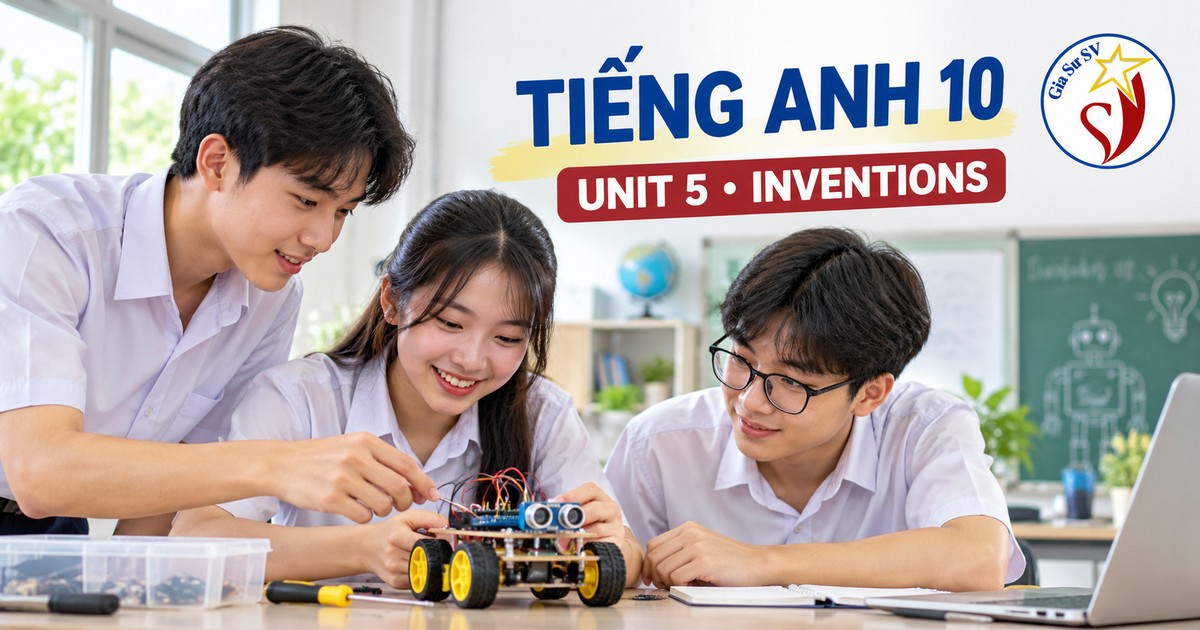
Học chủ đề các phát minh qua ví dụ gần gũi, cấu trúc được giải thích bằng tiếng Việt và bài tập tự luyện. Nội dung theo trọng tâm Unit 5 của Tiếng Anh 10 Global Success.
1. Từ vựng theo chủ đề
Đọc câu ví dụ, sau đó thay một chi tiết để tạo câu của em.
| Từ/cụm từ | Nghĩa | Ví dụ |
|---|---|---|
| invention | phát minh | This invention saves time. |
| device | thiết bị | The device is easy to use. |
| portable | dễ mang theo | A portable charger is useful. |
| charge | sạc | Charge the battery before use. |
| application | ứng dụng | The application helps us learn. |
| artificial intelligence | trí tuệ nhân tạo | Artificial intelligence can support some tasks. |
| experiment | thí nghiệm | We repeated the experiment. |
| benefit | lợi ích | The invention has several benefits. |
| convenient | tiện lợi | Online dictionaries are convenient. |
| effective | hiệu quả | We need an effective solution. |
| sensor | cảm biến | A sensor detects obstacles. |
| prototype | nguyên mẫu thử nghiệm | The prototype still needs testing. |
2. Ngữ pháp và cách vận dụng
Hiện tại hoàn thành
S + have/has + V3. Dùng cho trải nghiệm, kết quả còn liên quan hiện tại hoặc việc bắt đầu trước đây còn tiếp tục. We have tested the robot three times. She has used this device since May. Phủ định: have/has not + V3; câu hỏi: Have/Has + S + V3?
Since, for, already, yet
Since + mốc bắt đầu: since 2024; for + khoảng thời gian: for two years. Already thường trong câu khẳng định; yet thường ở cuối câu hỏi hoặc phủ định. We have already finished. Have you finished yet? Khi nêu thời điểm quá khứ đã kết thúc, dùng quá khứ đơn: We tested it yesterday.
Diễn tả công dụng
Be used to + V hoặc be used for + V-ing: This app is used to practise pronunciation / for practising pronunciation. Dùng to V để chỉ mục đích: I use a tablet to read. Phân biệt be used to V (được dùng để) với be used to V-ing (quen với) qua ý nghĩa và cấu trúc.
Ví dụ có hướng giải
The team ___ built a robot. (have/has)
- Xác định chủ ngữ, ý nghĩa và dấu hiệu thời gian hoặc cấu trúc được yêu cầu.
- Team được xem là một nhóm đơn nhất trong câu này.
- Điền đáp án: has; đọc lại toàn câu để kiểm tra sự hòa hợp.
Lỗi thường gặp
| Câu cần sửa | Cách sửa | Vì sao |
|---|---|---|
| I have bought this charger yesterday. | I bought this charger yesterday. | Yesterday yêu cầu quá khứ đơn trong ngữ cảnh này. |
3. Phát âm
Luyện trọng âm danh từ ba âm tiết: com-PU-ter /kəmˈpjuːtə/, E-le-phant /ˈelɪfənt/, SCI-en-tist /ˈsaɪəntɪst/. Đọc âm tiết nhấn rõ hơn, giữ các âm tiết khác nhẹ. Với invention /ɪnˈvenʃən/, nhấn âm tiết thứ hai. Đếm âm tiết theo âm thanh, không theo chữ cái.
Đọc chậm rồi tăng tốc vừa phải. Có thể đối chiếu âm thanh từ điển hoặc học liệu nghe của lớp để tự sửa.
4. Hội thoại và luyện nói
A: Have you tested the device yet?
B: Yes. We have tested it three times.
A: What is it used for?
B: It is used for carrying small boxes.
Luyện theo cặp, đổi vai và thay thông tin bằng tình huống của em. Nói rõ ý, đưa thêm một lý do và phản hồi lịch sự.
5. Bài tập có đáp án
Làm trước khi mở lời giải. Với câu viết, có thể có nhiều đáp án đúng; bài mẫu dùng để đối chiếu cách triển khai và cấu trúc.
Từ vựng, ngữ pháp và phát âm · Câu 1–10
Câu 1. The team ___ built a robot. (have/has)
Xem đáp án và giải thích câu 1
has
Team được xem là một nhóm đơn nhất trong câu này.
Câu 2. We have ___ the device three times. (test)
Xem đáp án và giải thích câu 2
tested
Hiện tại hoàn thành cần V3.
Câu 3. She has used it ___ May. (since/for)
Xem đáp án và giải thích câu 3
since
May là mốc bắt đầu.
Câu 4. They have worked on it ___ two months. (since/for)
Xem đáp án và giải thích câu 4
for
Two months là khoảng thời gian.
Câu 5. Have you finished ___? (yet/already; neutral question)
Xem đáp án và giải thích câu 5
yet
Yet thường dùng cuối câu hỏi trung tính.
Câu 6. We ___ it yesterday. (test)
Xem đáp án và giải thích câu 6
tested
Yesterday là thời điểm quá khứ đã kết thúc.
Câu 7. This device is used for ___ boxes. (carry)
Xem đáp án và giải thích câu 7
carrying
For + V-ing chỉ công dụng.
Câu 8. We use a tablet ___ read books. (to/for)
Xem đáp án và giải thích câu 8
to
To + V chỉ mục đích.
Câu 9. What does portable mean?
Xem đáp án và giải thích câu 9
Easy to carry or move.
Portable là dễ mang theo.
Câu 10. Which syllable is stressed in invention?
Xem đáp án và giải thích câu 10
The second syllable: in-VEN-tion.
Trọng âm ở ven.
Đọc hiểu · Câu 11–16
A group of students in our technology club has built a small robot to carry lightweight classroom materials. The idea came from a teacher who often moved notebooks between two nearby rooms. The students did not begin by choosing the most impressive technology. They first measured the route and asked what the teacher actually needed.
Their prototype uses a simple sensor to detect obstacles. It stops when an object is too close, and a student can also stop it with a button. The robot is used for carrying small boxes on a flat indoor surface. It is not designed to carry people, climb stairs or work without supervision. The group includes these limits in every demonstration.
So far, the students have tested the device twelve times. During an early test, a wheel came loose, so they strengthened its connection. They have also reduced the robot's speed to make it easier to control. Keeping a notebook of changes has helped them compare each version instead of relying on memory.
The students are proud of their invention, but they know it is still a prototype. Before anyone uses it regularly, it needs more testing and a teacher's approval. Their next goal is to make the controls clearer. The project has shown them that an invention does not have to be complicated to be useful. A good design responds to a real problem and communicates its limits honestly.
Câu 11. Why did the students start the project?
Xem đáp án và giải thích câu 11
To help a teacher move lightweight classroom materials.
Đoạn đầu nêu nhu cầu.
Câu 12. What does the sensor detect?
Xem đáp án và giải thích câu 12
Obstacles.
Câu đầu đoạn hai.
Câu 13. Can the robot climb stairs?
Xem đáp án và giải thích câu 13
No. It is not designed to climb stairs.
Giới hạn được nêu rõ.
Câu 14. How many tests have they completed?
Xem đáp án và giải thích câu 14
Twelve.
Đầu đoạn ba.
Câu 15. Why did they reduce its speed?
Xem đáp án và giải thích câu 15
To make it easier to control.
Đoạn ba nêu mục đích.
Câu 16. What is their next goal?
Xem đáp án và giải thích câu 16
To make the controls clearer.
Đoạn cuối.
Viết và vận dụng · Câu 17–20
Câu 17. Rewrite with for: We use the robot to carry books.
Xem đáp án và giải thích câu 17
We use the robot for carrying books.
To V và for V-ing diễn tả công dụng.
Câu 18. Correct: I have bought this charger yesterday.
Xem đáp án và giải thích câu 18
I bought this charger yesterday.
Yesterday yêu cầu quá khứ đơn trong ngữ cảnh này.
Câu 19. State a benefit and a limitation of an electronic dictionary.
Xem đáp án và giải thích câu 19
It helps me check words quickly, but I still need to learn how to use them in context.
Đáp án mẫu cân bằng lợi ích và hạn chế.
Câu 20. Write 120–150 words describing a useful invention.
Xem đáp án và giải thích câu 20
Plan: introduce it; explain two uses and benefits; describe a limitation; give advice for responsible use.
Bài mẫu:
An electronic dictionary is one of the most useful inventions for my English study. I use it to check the meaning and pronunciation of unfamiliar words. It is also useful for finding example sentences, which show how a word works in context. Since I started using one, I have become more careful about choosing the right meaning. However, a dictionary cannot learn for me. If I copy every explanation without thinking, I may forget the word quickly. I therefore write one short example of my own after checking a new word. I also compare information when an entry is unclear. The device is convenient because I can carry it on my phone, but I turn off unrelated notifications while studying. Used thoughtfully, it supports independent learning.
Có ít nhất một cấu trúc chỉ công dụng; giải thích lợi ích qua ví dụ cụ thể, không khẳng định thiết bị luôn chính xác.
6. Quan sát ảnh và dùng tiếng Anh
Quan sát ảnh đầu bài. Trả lời bằng câu đầy đủ, dùng chi tiết nhìn thấy hoặc liên hệ hợp lý với chủ đề.
Câu 21. What are the students demonstrating?
Xem đáp án và giải thích câu 21
They are demonstrating a small robot car.
Đối chiếu chi tiết có trong ảnh, rồi chọn từ vựng phù hợp.
Câu 22. Write two sentences about the picture or a related situation.
Xem đáp án và giải thích câu 22
The students have built a robot model. It can help them learn about sensors and design.
Đáp án mẫu; một câu mô tả hoặc nhận diện chi tiết, một câu liên hệ chủ đề. Các cách diễn đạt đúng khác đều được chấp nhận.
7. Ghi nhớ cuối bài
S + have/has + V3.
Since + mốc bắt đầu: since 2024; for + khoảng thời gian: for two years.
Be used to + V hoặc be used for + V-ing: This app is used to practise pronunciation / for practising pronunciation.
Đặt hai câu mới, giải thích một lỗi thường gặp và làm lại câu đã sai sau một ngày.
Biên soạn: Gia Sư SV.