
Tiếng Anh 9 Unit 9: World Englishes – Lý thuyết và bài tập
Tiếng Anh 9 Unit 9 – World Englishes giúp em ôn chủ đề tiếng anh trên thế giới qua từ vựng, ngữ pháp, phát âm, hội thoại và 20 bài tập có lời giải. Bài học thuộc bộ Global Success.
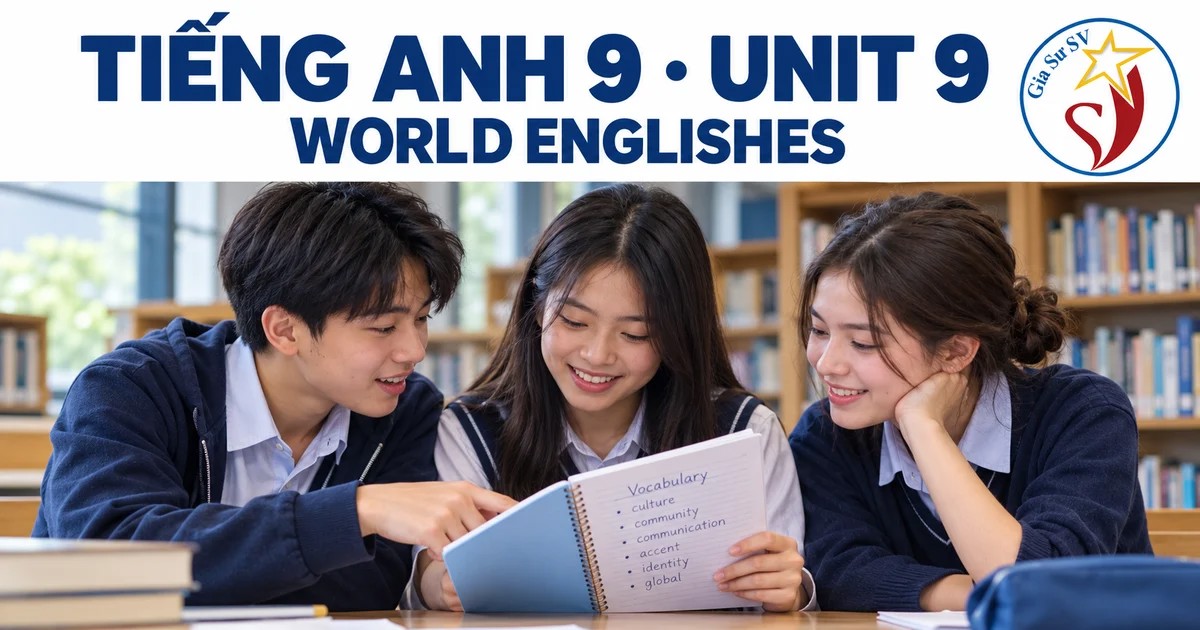
1. Từ vựng theo chủ đề
Đọc từ cùng câu ví dụ, sau đó thay một chi tiết để đặt câu của riêng em.
| Từ/cụm từ | Nghĩa | Ví dụ |
|---|---|---|
| accent | giọng phát âm | People speak with different accents. |
| variety | biến thể, dạng | We heard several varieties of English. |
| fluency | sự trôi chảy | Regular practice can improve fluency. |
| accuracy | sự chính xác | Check your sentences for accuracy. |
| borrowed word | từ vay mượn | A borrowed word comes from another language. |
| mother tongue | tiếng mẹ đẻ | Vietnamese is my mother tongue. |
| vocabulary | vốn từ | Reading helps me build vocabulary. |
| pronunciation | cách phát âm | I check the pronunciation of new words. |
| context | ngữ cảnh | Context helps me guess a word’s meaning. |
| communicate | giao tiếp | We use English to communicate. |
| expression | cách diễn đạt | This expression is useful in conversation. |
| dictionary | từ điển | A dictionary gives examples. |
2. Ngữ pháp dễ hiểu
Mệnh đề quan hệ xác định
Cung cấp thông tin cần để biết chính xác người/vật đang nói đến. Đặt ngay sau danh từ và không ngăn bằng dấu phẩy.
The student who sits near me speaks two languages. → Xác định học sinh nào.
Đại từ và khả năng lược bỏ
Who/that cho người; which/that cho vật; whose + danh từ chỉ sở hữu. Có thể lược đại từ làm tân ngữ trong mệnh đề xác định; không lược đại từ làm chủ ngữ.
The word (which/that) I learned is useful. / The word that appears here is new.
Không lặp thành phần đã được thay
Đại từ quan hệ đã thay cho danh từ trước nó; không thêm it/them/he trong cùng vai trò. Động từ của mệnh đề quan hệ phải phù hợp danh từ được bổ nghĩa.
The learners who practise daily improve steadily.
Ví dụ giải từng bước
Có thể bỏ which trong “the book which I bought” không?
- I là chủ ngữ, bought là động từ; which thay book làm tân ngữ.
- Trong mệnh đề xác định, đại từ làm tân ngữ có thể được lược.
Hoàn chỉnh: the book I bought
3. Phát âm và cách luyện
Từ có đuôi -ion thường nhấn âm tiết ngay trước đuôi: communiCAtion, eduCAtion. Với -ity thường nhấn âm tiết thứ ba từ cuối: aBIlity, uniVERsity. Chữ viết hoa ở đây đánh dấu phần nhấn, không phải cách viết từ thông thường.
Đọc chậm từng từ, đọc cả cụm rồi tự ghi âm để đối chiếu với mẫu đọc của giáo viên. Chú ý âm cuối và từ được nhấn.
4. Luyện nói qua hội thoại
A: What does this expression mean?
B: It means that something is very easy.
A: Could you give me an example?
B: Of course. Let us put it in a short dialogue.
Luyện theo cặp: đọc một lượt, đổi vai, sau đó thay một thông tin và hỏi thêm một câu. Cố gắng trả lời bằng câu đầy đủ.
5. Lỗi thường gặp
| Cách viết/hiểu cần sửa | Cách dùng đúng | Ghi nhớ |
|---|---|---|
| the word that I learned it | the word that I learned | Không lặp it. |
| the student, who sits next to me,… để xác định ai | the student who sits next to me… | Mệnh đề xác định không ngăn bằng dấu phẩy. |
| the boys who speaks | the boys who speak | Động từ theo danh từ được bổ nghĩa. |
6. Bài tập Unit 9 có đáp án
Làm từng câu trước khi mở đáp án. Với câu viết, em có thể diễn đạt khác nếu đúng nghĩa và ngữ pháp.
Câu 1. The dictionary ___ I use has clear examples.
- who
- which
- whose
- where
Xem đáp án và giải thích câu 1
B. which
Dictionary là vật; which là tân ngữ của use.
Câu 2. The learner ___ practises every day often improves.
- whose
- where
- who
- which
Xem đáp án và giải thích câu 2
C. who
Learner chỉ người; who làm chủ ngữ.
Câu 3. Choose the sentence with a correctly omitted relative pronoun.
- The learner practises daily is confident.
- The dictionary which I use it is new.
- The girl speaks English sits here.
- The word I learned yesterday is useful.
Xem đáp án và giải thích câu 3
D. The word I learned yesterday is useful.
Word là tân ngữ của learned nên lược được which/that. Các câu khác thiếu chủ ngữ quan hệ hoặc lặp tân ngữ it.
Câu 4. The students who ___ in this club speak different languages.
- study
- studies
- studying
- has studied
Xem đáp án và giải thích câu 4
A. study
Who thay students số nhiều nên study.
Câu 5. Choose the correct sentence.
- The phrase that she taught me it is useful.
- The phrase that she taught me is useful.
- The phrase who she taught me is useful.
- The phrase whose she taught me is useful.
Xem đáp án và giải thích câu 5
B. The phrase that she taught me is useful.
That đã thay phrase làm tân ngữ; không thêm it.
Câu 6. Chọn phản hồi phù hợp nhất: “I do not understand that expression.” – “___”
- The notebook belongs to my cousin.
- The lesson ended ten minutes ago.
- Let me explain it with an example.
- I usually travel to school by bus.
Xem đáp án và giải thích câu 6
C. Let me explain it with an example.
Đưa ví dụ là cách giải thích hỗ trợ người học.
Câu 7. Điền who hoặc which: A dictionary ___ gives examples can help learners.
Xem đáp án và giải thích câu 7
which
Dictionary là vật.
Câu 8. Điền whose hoặc who: I know a student ___ mother tongue is Thai.
Xem đáp án và giải thích câu 8
whose
Whose + mother tongue chỉ sở hữu.
Câu 9. Chia hiện tại đơn của speak: The boy who ___ two languages is my friend.
Xem đáp án và giải thích câu 9
speaks
Who thay boy số ít.
Câu 10. Điền can hoặc cannot: In “the girl who helps me”, we ___ omit who.
Xem đáp án và giải thích câu 10
cannot
Who làm chủ ngữ của helps nên không được lược.
Câu 11. Từ/cụm từ nào có nghĩa “giọng phát âm”?
- variety
- fluency
- accuracy
- accent
Xem đáp án và giải thích câu 11
D. accent
accent: giọng phát âm. Ví dụ: People speak with different accents.
Câu 12. Từ/cụm từ nào có nghĩa “biến thể, dạng”?
- variety
- fluency
- accuracy
- borrowed word
Xem đáp án và giải thích câu 12
A. variety
variety: biến thể, dạng. Ví dụ: We heard several varieties of English.
Câu 13. Từ/cụm từ nào có nghĩa “sự trôi chảy”?
- accuracy
- fluency
- borrowed word
- mother tongue
Xem đáp án và giải thích câu 13
B. fluency
fluency: sự trôi chảy. Ví dụ: Regular practice can improve fluency.
Câu 14. Từ/cụm từ nào có nghĩa “sự chính xác”?
- borrowed word
- mother tongue
- accuracy
- vocabulary
Xem đáp án và giải thích câu 14
C. accuracy
accuracy: sự chính xác. Ví dụ: Check your sentences for accuracy.
Đoạn văn đọc hiểu
Câu 15. What surprised Phuc at first?
- Everyone had the same accent.
- Nobody asked questions.
- All members attended his school.
- Differences in pronunciation and expressions.
Xem đáp án và giải thích câu 15
D. Differences in pronunciation and expressions.
Phuc nhận ra khác biệt về âm, nhịp và cách diễn đạt.
Câu 16. What did the teacher encourage?
- Asking polite questions.
- Calling every difference wrong.
- Avoiding all unfamiliar speakers.
- Copying only one student.
Xem đáp án và giải thích câu 16
A. Asking polite questions.
Giáo viên khuyến khích hỏi lịch sự thay vì vội kết luận sai.
Câu 17. Which item was in Phuc’s notebook?
- Every member’s home address.
- A sentence showing the expression’s context.
- Only an isolated translation.
- A list of exam scores.
Xem đáp án và giải thích câu 17
B. A sentence showing the expression’s context.
Sổ gồm từ/cụm, giải thích và câu ngữ cảnh.
Câu 18. What became Phuc’s main goal?
- Copying every accent exactly.
- Using only rare words.
- Speaking clearly and understanding different speakers.
- Avoiding dictionary examples.
Xem đáp án và giải thích câu 18
C. Speaking clearly and understanding different speakers.
Đoạn cuối nêu trọng tâm nói rõ và nhận ra cách diễn đạt khác nhau.
Câu 19. Nối bằng mệnh đề quan hệ xác định: I use a dictionary. It gives clear examples.
Xem đáp án và giải thích câu 19
Đáp án tham khảo
I use a dictionary which gives clear examples.
Which/that thay it làm chủ ngữ của gives; không có dấu phẩy.
Gợi ý tự đánh giá (1 điểm): Đúng cấu trúc trọng tâm: 0,5 điểm; giữ đúng nghĩa: 0,25 điểm; chính tả và dấu câu: 0,25 điểm.
Câu 20. Viết 100–120 từ về cách em muốn cải thiện vốn từ tiếng Anh.
Xem đáp án và giải thích câu 20
Đáp án tham khảo
To improve my English vocabulary, I want to learn words in meaningful contexts. When I read a short article, I choose a few useful expressions instead of copying every unfamiliar word. I check their meanings and pronunciation in a dictionary, then write my own examples. I also review the expressions after a few days and try to use them in conversation. If a word has several meanings, I note the meaning that fits the text first. My friend and I sometimes make short dialogues with our new vocabulary. This method takes regular practice, but it helps me remember how words are used rather than only their translations.
Bài mẫu gợi ý cách triển khai; có thể dùng ý tưởng khác phù hợp yêu cầu.
Gợi ý tự đánh giá (1 điểm): Đúng chủ đề và đủ ý: 0,4 điểm; ngữ pháp và từ vựng: 0,3 điểm; mạch lạc: 0,2 điểm; độ dài 100–120 từ, chính tả và dấu câu: 0,1 điểm.
7. Sơ đồ ghi nhớ
The student who sits near me speaks two languages. → Xác định học sinh nào.
The word (which/that) I learned is useful. / The word that appears here is new.
The learners who practise daily improve steadily.
Đặt hai câu theo chủ đề, nói một đoạn ngắn và làm lại những câu còn sai.